

reybets mobile casino bonus is a topic where the gap between what a listing says and what a reader can confirm on a phone is the central difficulty. Readers arriving at reybets2027.com often want a quick answer about mobile rewards, and this publication has not verified current availability of any specific bonus. This article therefore explains how mobile rewards are structured, how compatibility and channel differences affect what a reader sees, and which details remain uncertain.
Contents
Understanding the reybets mobile casino bonus Landscape
A bonus described as mobile-specific is usually a marketing label rather than a separate product. The same underlying promotion can be presented on a phone and on a desktop, with different wording and different conditions attached. The label tells a reader where the promotion is being promoted, not whether the terms differ in substance. Treating "mobile" as a category of offer invites assumptions that the documentation may not support.
The first practical problem is that listings age. A page that once described a mobile reward may still be indexed long after the terms changed or the promotion ended. Because a listing is historical, it cannot confirm that the benefit exists today. A reader who sees a familiar brand name and an attractive description has learned only that someone, at some point, published that description. That is not evidence of a current offer.
Mobile presentation also compresses information. A phone screen shows a headline and a call to action, while qualifiers such as eligibility, wagering conditions and expiry sit further down or behind a link. This layout encourages readers to act on the headline alone. The editorial position here is that a headline without its conditions is not a usable fact. A promotion described in one line on a phone is not the same promotion once the full terms are read.
There is also the question of who is speaking. A bonus description may come from an operator, an affiliate, a forum post or an outdated mirror of a page. Each of these has a different reliability. An operator's own terms document carries more weight than a third-party summary, but even that document must be current. Without an identifiable, current source, a mobile bonus claim stays unverified regardless of how often it is repeated.
Finally, readers should separate the idea of a mobile bonus from the idea of mobile access. A site may work well on a phone while offering no distinct mobile reward at all. Conversely, a promotion may be labelled for mobile users while being available through any device. The two questions are related but not identical, and conflating them is one of the most common sources of confusion in this area.
A hypothetical reader sees a phone banner promising a mobile reward and forwards it to a friend before reading further. If the underlying terms were revised after that banner was captured, the friend inherits a stale claim and may plan around a benefit that no longer matches its description. The forwarding itself changes nothing about the offer's status.
A different documentary check concerns archived copies. A saved page can look complete while missing the revision notice that sits elsewhere on the live site, so the archive supports only what was published at capture, not current terms. Where the revision history cannot be identified, the claim stays unverified.
What a Phone Screen Shows That a Desktop Page Hides
The most concrete difference between mobile and desktop presentation is what fits above the fold. On a phone, the first screen typically holds a headline, a short description and a button. The conditions that determine whether a reader qualifies usually sit below that point. A reader who screenshots the headline has captured the claim but not the qualification, and the qualification is the part that matters.
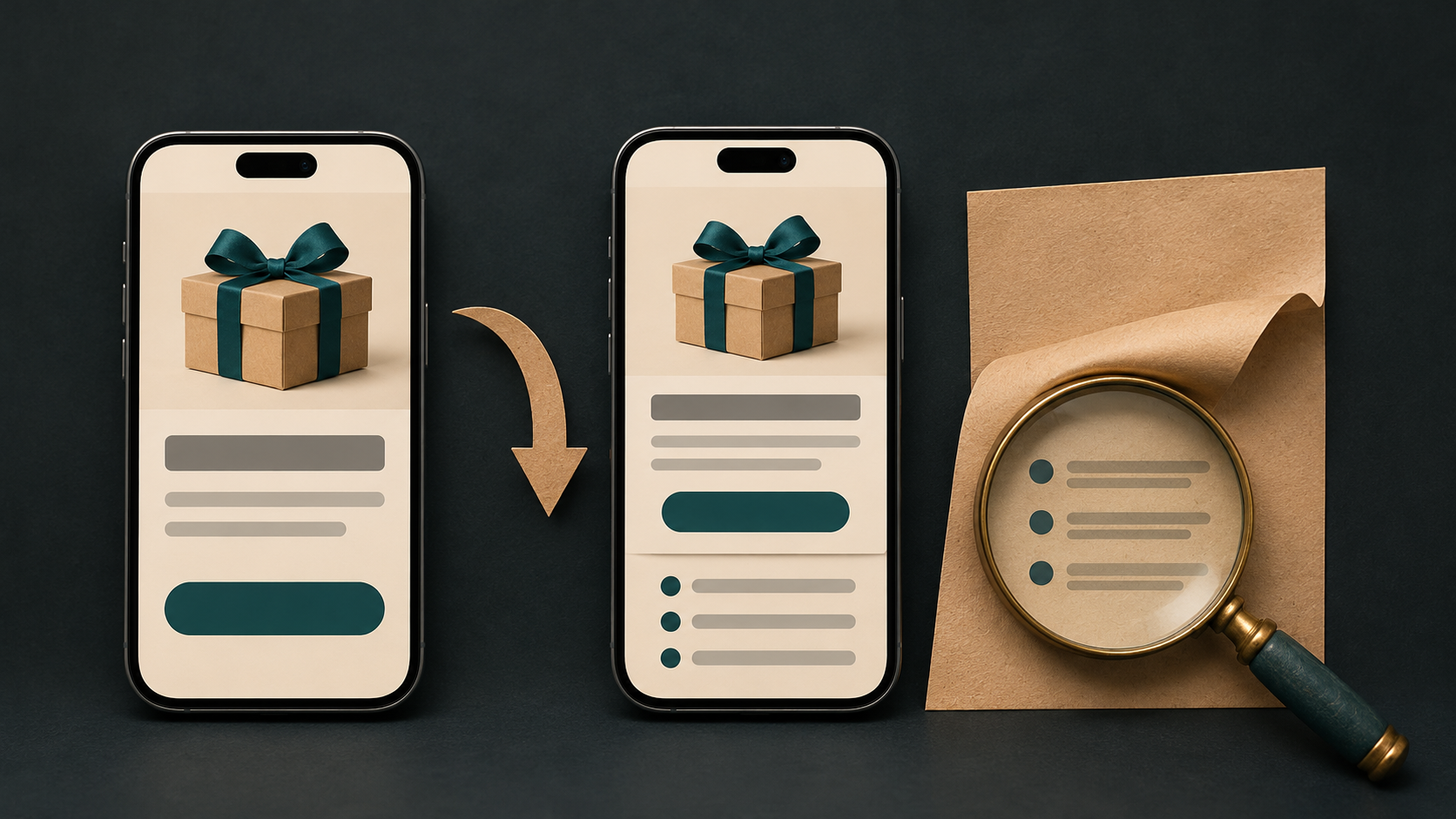
Consider a hypothetical reader who sees a mobile page describing a reward and forwards a screenshot to a friend. The friend sees a headline with no conditions attached. Neither person can tell from the image whether the reward applies to new accounts only, whether it requires a minimum deposit, or whether it expired last month. The screenshot is a record of what was displayed, not a record of what is available. This distinction is worth stating plainly because screenshots circulate widely.
Mobile layouts also change over time without announcement. A design refresh can move a terms link, rename a section or remove a description entirely. A reader comparing a phone screen today with a description written months ago may be looking at two different versions of the same page. Neither version is necessarily wrong, but the older description cannot vouch for the newer screen. Freshness has to be checked at the source, not inferred from memory.
Push notifications and in-app messages add another layer. A message that arrives on a phone may reference a promotion without reproducing its terms. The message is a prompt, not a contract. Readers sometimes treat a notification as confirmation that an offer exists and applies to them. In practice, a notification confirms only that a message was sent. The terms behind it still need to be located and read in full before any conclusion is drawn.
The practical remedy is unglamorous. Read the conditions on the page where the promotion is described, check whether the page identifies who published it and when, and look for a terms document that stands on its own. If the only description is a headline, the reader has a claim without support. That is the situation the editorial policy here is designed to flag rather than smooth over.
Compatibility Questions Behind Mobile Rewards
Compatibility is often discussed as though it were a single yes-or-no question. In practice it splits into several: whether the site loads on a given device, whether the account functions work in the browser being used, and whether any promotion described is tied to a particular way of accessing the site. These are separate questions, and an answer to one does not settle the others. A page that loads is not proof that every feature works.

A hypothetical case makes the split visible. Suppose a reader opens a site on an older phone and finds that a page loads but a section does not respond. The reader might conclude the promotion is unavailable on mobile. A more careful reading would note that the page loaded, so the site is reachable, but one component failed. That failure says something about the device and browser combination, not necessarily about the promotion itself. The two conclusions are different and lead to different next steps.
Browser behaviour matters for the same reason. Different browsers render and script pages differently, and a feature that works in one may not work in another. When a reader reports that a mobile page behaved unexpectedly, the useful details are the device, the browser and the exact step that failed. Without those details, a report describes a feeling rather than a reproducible problem. Reproducibility is what turns an anecdote into evidence.
There is also a distinction between technical compatibility and eligibility. A site may work perfectly on a phone while a promotion remains restricted to certain readers. Technical access and promotional eligibility are governed by different rules. A reader who can log in has established access, not entitlement. Confusing the two is common because both are experienced as "it worked" or "it did not work" on the same screen.
The editorial approach here is to keep these threads separate. Compatibility claims require a described device and browser, and promotion claims require a current terms document. Neither substitutes for the other. A reader who holds both pieces of information is in a position to draw a conclusion. A reader who holds only one is guessing, however confidently.
The compatibility split becomes clearer when a hypothetical reader keeps a short written record during a failed attempt rather than relying on memory afterward. Suppose a reader on a mid-range phone notices that the site loads but a bonus section shows a blank panel. Nothing else fails. The reader writes down the phone model, the browser name and version, the network type, and the exact step at which the panel stayed empty. That record does not prove the promotion is unavailable on phones. It documents one device, one browser and one failure point.
Read alongside a second report from a different device where the same panel loads, the record points toward a rendering or scripting problem on that combination rather than a rule about mobile access. The value lies in the pairing. A single report can be read as a verdict about the whole promotion, while two comparable reports narrow the question to something testable.
The documentary check that changes the analysis most often involves the wording that defines who may claim a benefit, not the wording that describes the benefit. Many readers collect the headline description and stop there. The eligibility clause and the participation conditions sit elsewhere in the same terms document, and they can contradict a conclusion drawn from the headline alone. A hypothetical reader might find a bonus described as available to mobile users and conclude that any phone qualifies. The conditions might instead tie the benefit to a registration route, an account status or a verification step that has nothing to do with the device.
If those conditions are present, the device question is secondary. If they are absent, the reader still cannot assume they do not exist elsewhere in the document. The absence of a clause in one section is not proof that the document is silent on the point.
An exception worth separating from compatibility is the case where a page loads and the account works, but the reader cannot tell whether a promotion they saw earlier is the same one now referenced. Promotions change, and a description captured weeks ago may describe a different arrangement than the one currently documented. A reader comparing an old screenshot with a current terms page is comparing two different things. The screenshot records what a page displayed at a moment. The terms page records what the publisher currently states. When they disagree, neither automatically overrides the other. The useful step is to note the disagreement and treat the earlier capture as historical.
These threads lead to different consequences. A reproducible technical failure calls for reporting the device and browser details to the site, because the problem may be fixable. An eligibility mismatch calls for reading the participation conditions closely, because the device is not the obstacle. A stale description calls for locating a current document, because the older text may no longer apply. Treating all three as one problem produces a confident conclusion that rests on the wrong cause.
The practical habit is to keep the evidence types apart. Device and browser details answer questions about access. Current terms answer questions about entitlement. A dated capture answers questions about what was shown before. Each supports a narrow conclusion and none supports the others. A reader who can say which question they are actually asking is less likely to mistake a loading failure for a rule, or a headline for a condition.
Channel Differences and Why a Listing Is Not a Live Offer
Rewards reach readers through several channels: operator pages, affiliate listings, social posts, messaging groups and forwarded screenshots. Each channel has its own incentive and its own lag. An affiliate listing may be written to attract clicks and updated infrequently. A social post may be a snapshot of a moment. A messaging group may circulate text that originated somewhere else entirely, with no attribution. The channel shapes the claim as much as the underlying promotion does.

This is why a supplied listing is treated here as historical. It records that a description existed, not that the described benefit is available now. The distinction matters most when a listing is detailed and specific, because specificity creates an impression of authority. A precise description of a mobile reward feels more trustworthy than a vague one, yet precision in a stale document is still stale. Detail is not the same as currency.
Channel differences also affect what can be verified. An operator's own terms document can be checked against its publisher and date. A forum post usually cannot. A forwarded message cannot be traced at all. When the editorial policy says that service-specific statements need an identifiable, current source, it is drawing a line between claims that can be checked and claims that cannot. A familiar logo or a payment name appearing in a message does not move it across that line.
The practical consequence for readers is a habit of asking where a claim came from. If the answer is a page with a named publisher and a visible date, the claim can be assessed. If the answer is a message with no origin, the claim can only be noted. Noting is not dismissing. A noted claim may later be confirmed by a proper source. Until then, it sits in the category of things said rather than things established.
None of this means channels are equally unreliable in every case. It means reliability has to be argued rather than assumed. A channel that names its publisher, dates its material and links to terms is doing the work that makes verification possible. A channel that does none of these has left the reader with nothing to check, and the reader should treat that absence as informative in itself.
What Remains Uncertain and How This Article Is Maintained
Several things remain uncertain after a careful reading. The current availability of any mobile reward is unverified here. The terms that would govern such a reward are not reproduced because reproducing example terms as quotes would misrepresent them as real conditions. Whether a given reader would qualify depends on rules this article cannot see. These are not gaps to be filled by guesswork. They are the boundaries of what the available material supports.
The maintenance process is designed around those boundaries. When material information changes, the affected text is revised and the article's updated date is displayed. A date change alone does not refresh an unsupported claim, which is why the date sits alongside the substance rather than replacing it. Readers should read the date as a signal of when the text was last reviewed, not as proof that every statement in it is current. The two are related but distinct.
Some material in this article is explanatory rather than factual. The situations described to illustrate compatibility problems and channel lag are hypothetical examples, created to make a concept concrete. They are not records of actual accounts, transactions or games. Calculations and reader scenarios invented for explanation are labelled as examples for the same reason. The label tells the reader which sentences describe the world and which describe a way of thinking about it.
The editorial account behind this publication is a publishing identity, not a claim of first-hand testing. Contributor credentials, personal tests and individual results would require supporting evidence, and none is asserted here. AI tools assist with drafting and illustration, and factual claims, calculations, headings, links and structured data are reviewed before publication. Generated images are labelled as illustrations and do not stand in for real interface screenshots or testing evidence. This article contains no such images.
The sources that support named subjects do not imply that a regulator, technology provider or payment organisation endorses this website or any operator. Brand references identify the subject of the information and do not establish operator affiliation. These guides do not accept money, operate gaming accounts or guarantee a financial outcome. Readers should treat every promotional amount, payout schedule and acceptance claim as unverified unless a current document supports it. Gambling is for adults aged 18+ only. A random number generator (RNG) determines outcomes in RNG-based casino games. Wins are not guaranteed.
Independent support: Gambling Therapy.
Sources on this site: Editorial policy, Editorial contact, Promotions guide.
Image note: The cover is an AI-generated editorial illustration. A dark phone lies next to a partly open kraft envelope tied in teal ribbon.